
-
 September 29, 2026
-
0 Comments
-
By
satyaitsolution


 By
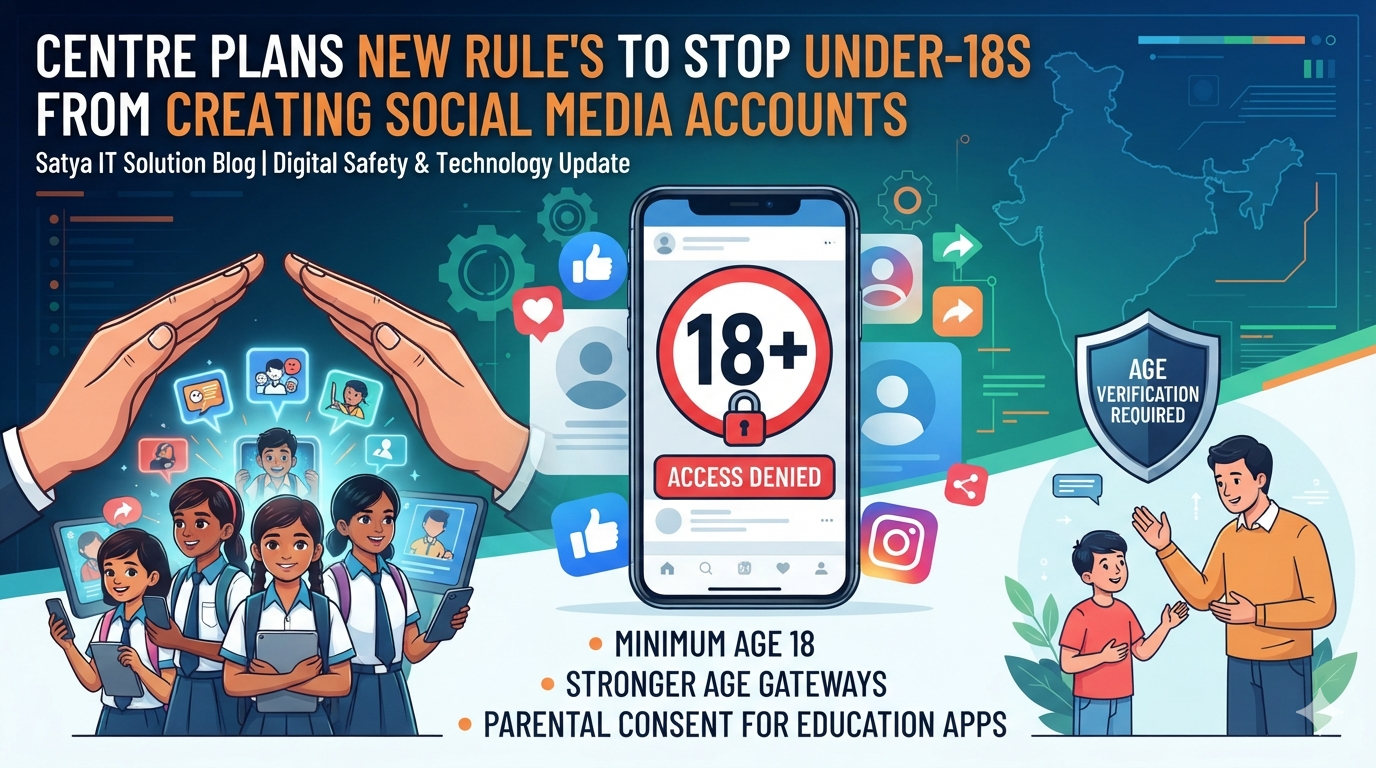
By Centre Plans New Rules to Stop Under-18s From Creating Social Media Accounts
Centre Plans New Rules to Stop Under-18s From Creating Social Media Accounts
Satya IT Solution Blog | Digital Safety & Technology Update
India is considering new legal measures that could prevent children below the age of 18 from independently creating social media accounts. The development comes after the Supreme Court raised concerns about minors being allowed to open and operate accounts on social media platforms.
The Centre has indicated that it is considering amendments to the Information Technology (Intermediary Guidelines and Digital Media Ethics Code) Rules, 2021, with the objective of requiring social media intermediaries to comply with Indian law regarding minors.
What Is the New Proposal?
The proposed framework could establish 18 years as the minimum age for independently creating social media accounts in India.
During proceedings before the Supreme Court, the government indicated that a statutory mechanism may be needed so that social media platforms are legally required to prevent minors from registering accounts.
The issue was considered by a bench headed by Chief Justice of India Surya Kant along with Justices Joymalya Bagchi and V. Mohana while hearing a petition concerning safeguards for children on social media.
Why Is the Government Considering These Rules?
The debate is primarily focused on online safety and the protection of children.
The petition before the Supreme Court highlighted risks including:
- Online grooming
- Cyberbullying
- Sexual exploitation
- Exposure to age-inappropriate content
- Misuse of children’s personal information
- Behavioural profiling
- Online trafficking-related risks
The government has also previously stated that India’s existing IT framework includes measures designed to protect children from harmful online content.
What Did the Supreme Court Say?
The Supreme Court questioned how social media platforms could allow children around 12 or 13 years old to independently create accounts when Indian law treats people below 18 as minors.
The Court asked the Centre to consider using the existing statutory framework to ensure that digital intermediaries’ systems comply with Indian law.
The Court has given the government time to consider the appropriate legal mechanism. Therefore, the proposed restriction should not be understood as an already implemented nationwide ban until the relevant rules or legal provisions are formally notified.
What Could Change for Social Media Platforms?
If the proposed framework becomes law, social media companies may need to introduce stronger age-verification and registration controls.
Possible areas of compliance could include:
- Age verification during account registration.
- Blocking registration by users below the prescribed age.
- Technology changes to ensure platforms follow Indian requirements.
- Additional safeguards for children’s personal data.
- Parental involvement where permitted for educational or other digital services.
The exact technical requirements will depend on the final rules notified by the government.
What About Educational Websites and Apps?
The discussion is not necessarily about preventing children from using every type of online service.
During the Supreme Court proceedings, the Centre indicated that parental consent could be relevant for services such as educational applications. This means the final framework may distinguish between social-media membership and other legitimate digital services used by children.
Parents and schools should therefore wait for the final government notification before assuming that every online account used by a person below 18 will be affected in the same way.
Why Age Verification Could Become Important
One of the major challenges for social media platforms will be determining a user’s actual age.
Simply asking a user to enter a date of birth may not be sufficient if the government introduces stronger age-verification requirements.
Platforms could potentially need technological mechanisms to establish whether a person meets the minimum age requirement while also considering privacy and data-protection requirements.
The details of such mechanisms have not yet been finally established.
What Parents Should Do Now
Regardless of the final legal framework, parents can take practical steps to improve children’s online safety.
Parents should:
- Talk to children about online privacy.
- Avoid sharing sensitive personal information publicly.
- Review privacy and security settings.
- Use parental controls where appropriate.
- Teach children how to identify suspicious messages and fake accounts.
- Encourage children to report bullying or inappropriate content.
- Avoid sharing photographs or personal details of children unnecessarily.
- Use strong passwords and enable two-factor authentication where available.
What Social Media Users Should Know
The proposed changes are part of a broader discussion about children’s digital safety in India.
The Centre has already been strengthening its approach to online safety, including action against unlawful and harmful content involving children. In July 2026, the Ministry of Electronics and Information Technology said intermediaries were required to follow due-diligence obligations under the IT Act and IT Rules.
The latest proposal could add another layer by addressing who can create and maintain social-media accounts.
Final Takeaway
India is moving towards a more formal legal framework for protecting minors on social media. The Centre has indicated that it may amend the IT Rules or introduce statutory measures to require platforms to prevent children under 18 from independently creating social media accounts.
However, the final rules, age-verification process, exemptions and implementation timeline are yet to be formally notified.
For parents, students, teachers, businesses and digital-service providers, the development is important because it could change how age verification, account registration and children’s online privacy are handled in India.
Satya IT Solution will continue to provide updates on important technology, digital safety, online services and government technology policies.